Are We Forgetting the Importance of Simply ‘Being With’?
Within psychotherapy, we often talk about the importance of relational presence — the experience of being emotionally available, attuned and alongside another person. It is not a technique or intervention, but a way of being. A willingness to slow down, pay attention and meet another person where they are.
Yet in many educational, special educational needs and disability (SEND) and therapeutic settings, where outcomes, interventions and measurable progress are understandably prioritised, I sometimes wonder whether the simple act of being with is being forgotten. Beyond schools and services, we are also living in a world that increasingly values speed, productivity and efficiency. Technology has transformed how we work, communicate and connect, bringing many benefits, but often placing screens between us and the people sitting right beside us.
Children are growing up in this environment too. Their lives are frequently structured around timetables, targets, activities and achievements. Adults, often stretched and overwhelmed themselves, can find their attention pulled in countless directions at once. In such a world, it can be easy to slip into doing rather than being; solving rather than listening; teaching rather than noticing.
Are we becoming so focused on helping children that we forget the value of simply being with them?
Not fixing.
Not directing.
Not assessing.
Just sitting alongside a child and sharing a moment of their experience.
It sounds deceptively simple, yet for many children this experience of being seen, felt and emotionally held may be one of the most important foundations for growth, learning and wellbeing. Perhaps before we ask what more we can do for children, we might first ask whether we are giving enough space to simply be with them.
As I’ve sat with this question, I’ve found myself wondering whether the issue is not that we have forgotten the importance of being,but that many of us are struggling to find space for it.
Teachers are working within increasingly stretched systems. Parents are juggling work, finances, family responsibilities and the relentless pace of modern life. Therapists are often required to demonstrate outcomes, evidence effectiveness and work within increasingly structured models of intervention.
In many ways, we are all being asked to do more than ever before.
Perhaps it is no surprise that being with a child can feel harder than it sounds.
I notice this in myself at times. As a psychotherapist, there are moments when I enter a session carrying a mental list of things I should be doing. Is the child making progress? Is there an intervention that might help? What will I feedback to parents, schools or other professionals?
None of these questions are unimportant. In fact, they are often necessary parts of responsible practice. Yet I have also noticed that when I become too focused on what I should be doing, I can become less available to what is actually happening in the room.
Sometimes the most meaningful moments emerge when I let go of the need to move things forward.
A child quietly drawing while I sit alongside them.
A teenager staring out of the window before finding the words to speak.
A non-verbal child carefully lining up objects while I resist the urge to ask what they mean.
These moments can feel deceptively ordinary. They may not look like progress in the way many systems define it. Yet beneath the surface, something important is often taking place. Safety is being built. Trust is being tested. A relationship is forming.
Perhaps the challenge is not that we have forgotten the art of being. Perhaps it is that we are living and working within systems that constantly pull our attention towards doing, making it easy to overlook the quieter work of simply being.
Or perhaps there is something else at play.
Maybe, when we sit alongside a child without directing, teaching, fixing or intervening, it can feel as though we are doing nothing at all.
Yet what if some of the most important developmental and therapeutic work happens precisely in those moments?
When Children Are Simply Met
When children are simply met rather than managed, something shifts. The child no longer needs to perform, achieve or explain themselves to be worthy of attention. Instead, they experience another person who is willing to stay alongside them, without needing to change, fix or move them.
Psychoanalyst and paediatrician Donald Winnicott wrote about the importance of "being" before "doing". Before children can confidently explore, learn and develop, they first need experiences of feeling safe, held and understood within relationships.
Through attunement, a child begins to feel that their inner experience makes sense to another person. Through attachment, they learn that relationships can be dependable. Through repeated experiences of co-regulation, their nervous system gradually learns how to regulate difficult feelings for itself.
In this sense, being with a child is far from passive. It may be one of the most active and transformative things we can offer.
Beyond Words
This feels particularly important when working with children whose communication extends beyond spoken language.
Many neurodivergent children, non-verbal children and children with complex SEND communicate through movement, behaviour, sensory exploration, play, rhythm, repetition and silence. Yet adults can sometimes feel pressure to translate these experiences into words too quickly.
What if the pouring, spinning, pacing, lining up, hiding, drawing or repetitive play is not something to move past, but something to stay with?
When words are limited, relationship often becomes the language. Presence communicates safety. Attunement communicates understanding. Being alongside quietly says, "I am here with you."
Sometimes, before children find words, they need someone willing to listen beyond them.
A Small Reflection
As I was writing this piece, I found myself returning to a moment from a recent session.
A child spent almost twenty minutes silently pouring water from one container to another.
Every part of me wanted to ask questions.
To understand.
To interpret.
To move the moment forward.
Yet when I resisted the urge to move the moment forward, something else emerged. The room became quieter. The child became calmer. We settled into a shared rhythm. Nothing dramatic happened, yet the moment felt significant.
It left me wondering how often children need us to witness their experience before they are ready to explain it.
So, I'll leave you with a question:
When was the last time you sat alongside a child without trying to teach, correct, reassure, distract or solve?
What happened in the space that remained?
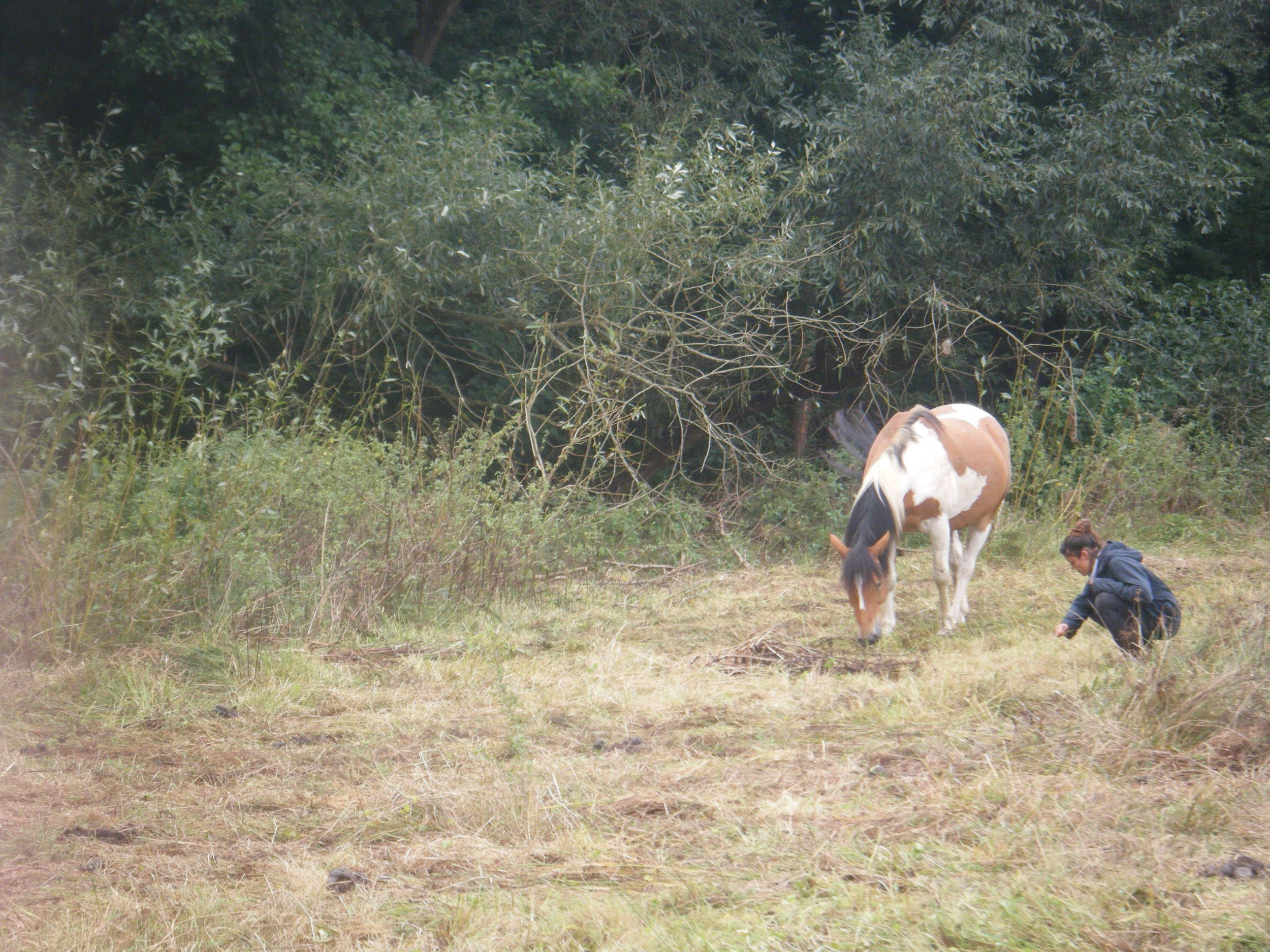
Grazing - Image C/o Sandy Reay